
Data-driven care for injectable medicine
Common Sensing succeeded in bringing a novel smart hardware device from concept to market in a difficult space.
Common Sensing is a healthcare technology company we created to transform home treatment of chronic disease. We developed a smart hardware device that empowered individuals to take control of their health in a highly regulated market where such advancements have been limited.
Our hardware product, Gocap, addressed a significant gap in chronic disease management, particularly for diabetes, the costliest chronic condition in the United States. We recognized that managing diabetes successfully happens outside clinic walls, in patients’ daily routines. Gocap integrates seamlessly into users’ lives, helping them better manage their condition and improve their health outcomes.

We engaged directly with hundreds of users to learn about their daily challenges and preferences. This collaborative process helped us navigate complex regulatory barriers while ensuring Gocap met both healthcare requirements and real user needs. Gocap became more than a medical device; it became an empowering lifestyle tool.
We created Gocap, a connected health product that acts as a “Fitbit for injectable medicine”.


In the United States, over $400 billion in direct medical costsAmerican Diabetes Association, “New American Diabetes Association Report Finds Annual Costs of Diabetes to be $412.9 Billion,” 2023 are attributed to diabetes. More than half of diabetes patients are not meeting their treatment goalsStuart A. Ross, “Breaking Down Patient and Physician Barriers to Optimize Glycemic Control in Type 2 Diabetes,” The American Journal of Medicine, September 2013. The diabetes treatment market is comparable in size to the entire consumer electronics industry, yet if half of Americans struggled this way to get value from all consumer electronics, it would signal an industry crisis.
I met my cofounders, Rich and Jamie, following a service design initiative I led at IDEO focused on insulin adherence. Gocap was conceived as a smart, connected cap for insulin pens that captures each dose without disrupting the patient’s flow, logs data via Bluetooth to a smartphone app, and allows users to share dosing information with clinicians in real time.
Gocap surrounds patients with a proactive support network. Real-time data sharing with clinicians provides support and accountability, helping both patients and providers catch potential issues early and adjust treatment as needed.
How Gocap works
Gocap replaces the disposable injector pen’s plastic cap with a smart version. Users remove it to take a dose and put it back when finished. Gocap records each dose automatically and transmits it to the user’s mobile app via Bluetooth.
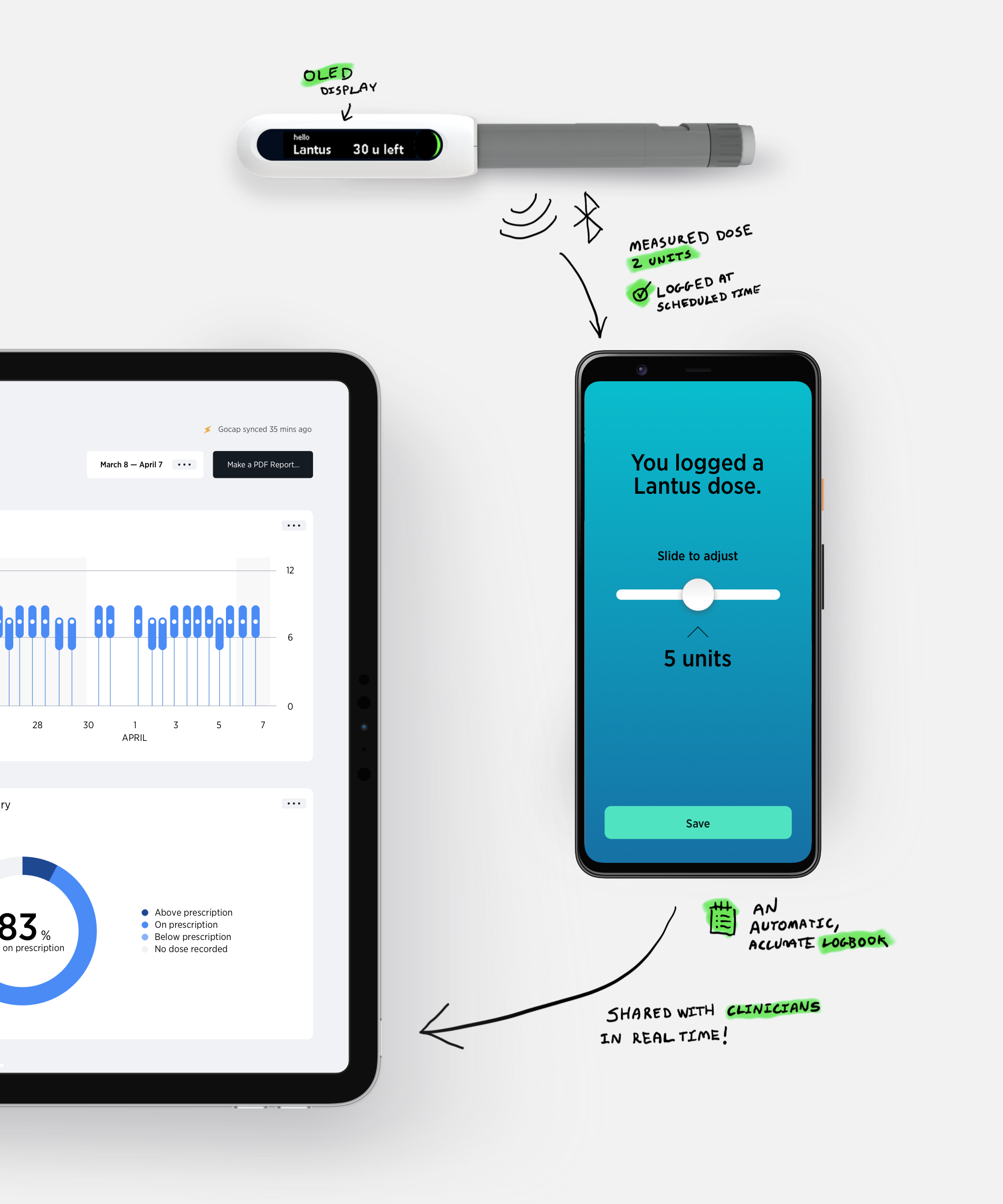
The companion app gives users a real-time view of their dosing history and patterns. Users can share this data with healthcare providers, allowing for continuous monitoring and support between doctor visits.
Getting the hardware right
Designing IoT hardware like Gocap is challenging due to limited iteration once production begins. Early prototypes used on-demand 3D printing, but full-scale production required expensive ABS molds costing up to $80K each. The product needed to be nearly flawless by manufacturing, as changes become costly.
One significant change was moving from an LCD to an OLED display. The OLED screen provided a versatile interface that could accommodate various information displays on a single SKU, allowing us to handle different user needs without requiring separate hardware versions.
I was particularly interested in the perceived differences in objects we have to use and objects we want to use. Many objects that meet health needs are perceived as scary, unappealing, or unworthy of public display. Not so for eyeglasses; they’re an article of fashion, even though they serve a medical purpose: correcting vision. What’s the delta between eyeglasses and a hearing aid?
By placing Gocap’s industrial design within the design language of consumer wearables and lifestyle products, we created a tool that people actually wanted to incorporate into their daily routine.
Co-designed by Gocap users
To ensure Gocap was intuitive and practical, especially for older adults managing diabetes, we conducted hundreds of hands-on usability studies. With terabytes of GoPro footage, we captured every movement, challenge, and triumph as users interacted with early prototypes, allowing us to refine every detail from grip comfort to display readability.
These studies aligned with FDA guidelines on user-centered design while helping us identify and resolve usability barriers. This collaborative approach ensured that Gocap felt empowering and accessible to its users.
Packaging design for easy onboarding
Since Gocap wouldn’t always be deployed in person, users needed to set up Gocap with their injectable medicine, charge it, download the app, and sync it over Bluetooth, all without intervention. Gocap’s packaging design made this possible by providing affordances and education during the unboxing process.
Gocap App featured design innovations that threw conventional UI out the window.
Designing the Gocap App presented unique challenges. Over a third of prospective users had never owned a smartphone before, so we had to rethink conventional digital design norms. Traditional affordances and cues were ineffective for this audience. I designed an interface for iOS and Android based on innovative, simplified guidelines:
- No navigational UI. Menus, drawers, and tabs were eliminated to prevent essential information from being hidden or difficult to find. The interface was designed to be as direct as possible.
- One screen, one action. Each screen shows only what users need to see at that moment, reducing cognitive load and guiding them step-by-step through their tasks.
- Low reliance on iconography. Icons were minimized and replaced with clear text labels, allowing users to understand and interact without needing to interpret unfamiliar symbols.
- Use color to create a sense of category and place. Consistent color-coding for core categories like medication types, glucose levels, and alerts helped users quickly orient themselves and understand each section’s purpose at a glance.

Gocap Dash let care providers focus on patients that need their attention.
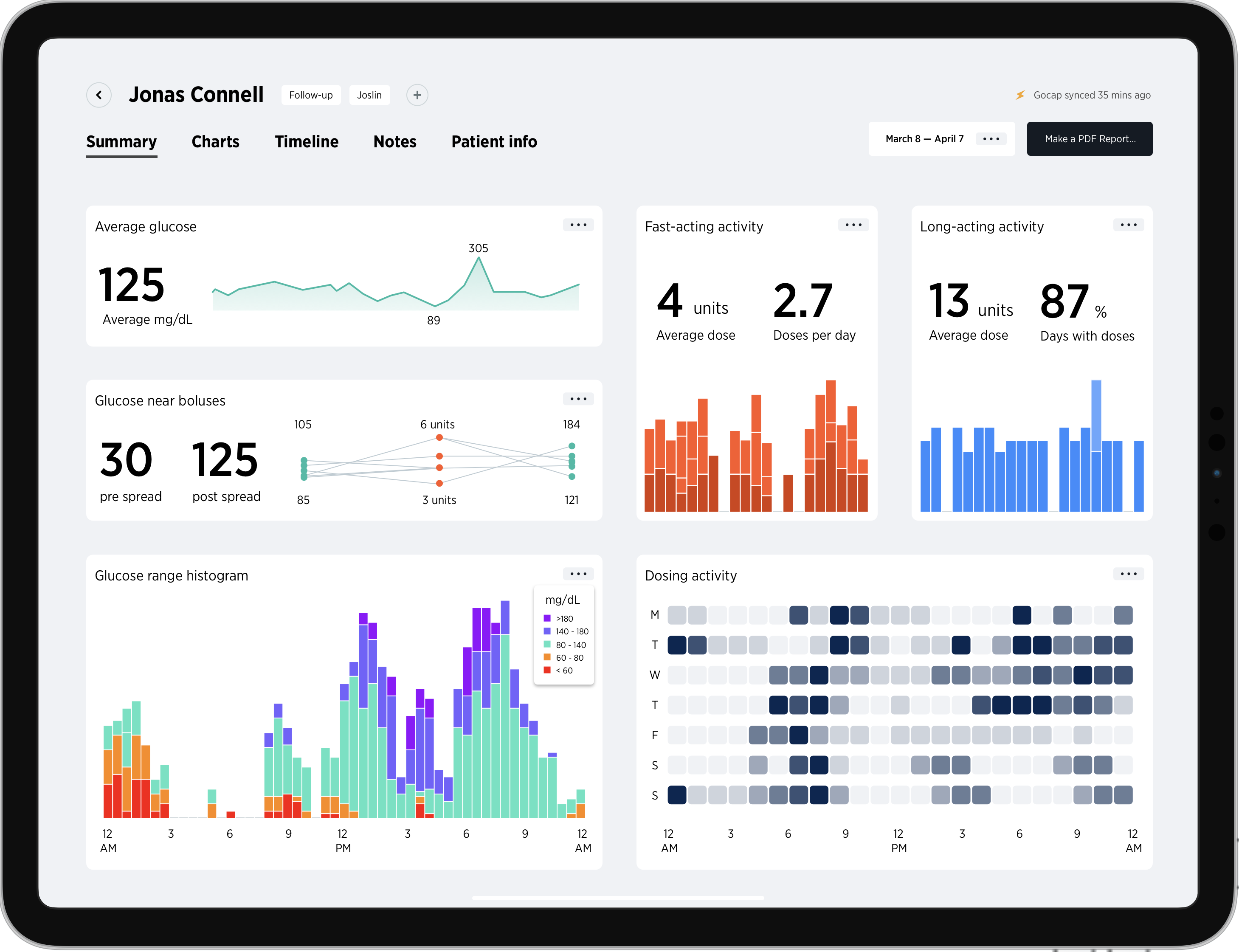
The care ecosystem for injectable medicine is intricate, involving patients, families, caretakers, healthcare providers, payers, and pharmacies. Gocap enabled data sharing with approved parties throughout this ecosystem, delivering insights that reduce costs and improve care quality.
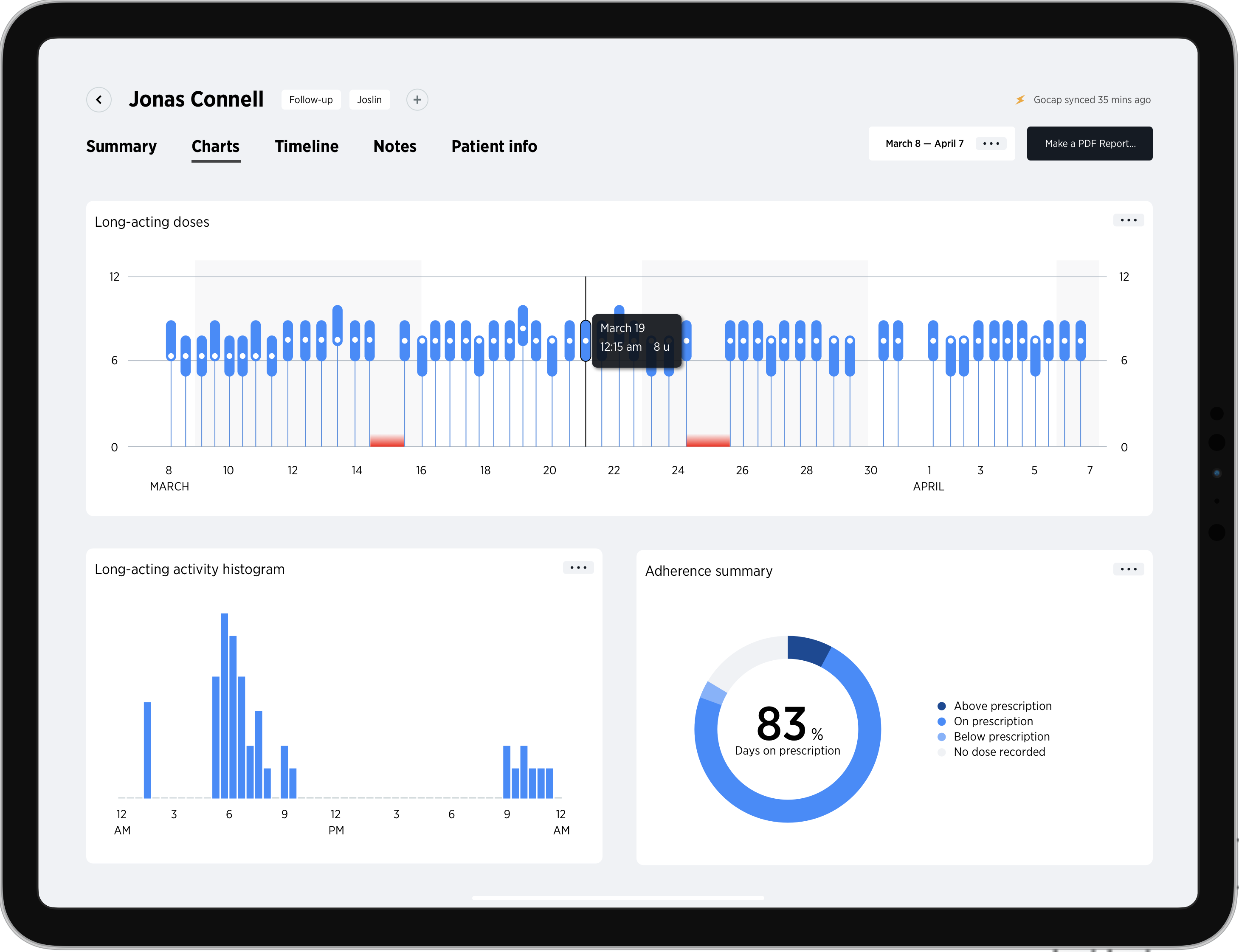
We developed Gocap Dash, a web application that highlights actionable insights from patient data. Gocap Dash organizes patient information at a population level, categorizing individuals by risk and identifying those in need of immediate intervention. Real-time dose information allows providers to monitor adherence closely, while built-in analytics identify behavioral patterns linked to treatment outcomes.
A unique problem: optimizing for fax machines
Not everyone in the care ecosystem could take advantage of Gocap Dash’s power. Many care providers were stuck using older computers running Windows XP after its end-of-life“IoT Threat Report,” Palo Alto Networks, March 10, 2020, or weren’t able to connect to the internet from systems where they handled patient information. We discovered that sending patient records over fax was one of the most common methods for transferring protected health data.
We implemented PDF exports and direct-to-fax capability, optimizing data visualizations to render well in the low-pixel scan area available in a typical fax.
Clinical outcomes
In partnership with the Joslin Diabetes Center, we conducted a pioneering connected health study that revealed Gocap’s tangible impact on clinical outcomes. The study demonstrated that Gocap users experienced improved health outcomes, including better insulin adherence and a reduction in missed doses.
Beyond individual outcomes, the study unearthed valuable insights into insulin use behavior on a broad scale. For the first time, we documented widespread challenges with insulin dosing, identifying specific patterns of non-adherence that had previously gone unnoticed. This behavioral data equipped healthcare providers with critical information, enabling them to address these issues proactively and develop more personalized treatment approaches.
Without Gocap, most people who use insulin have no access to data-driven support.
While most treatments for diabetes focus on patients with insulin pumps, this represents around 350k people who use insulinBrooke H. McAdams and Ali A. Rizvi, “An Overview of Insulin Pumps and Glucose Sensors for the Generalist,” Journal of Clinical Medicine, January 4, 2016. There are more than 7.2 million Non-pump insulin users in the United StatesIsrael Hodish, “Decades Into Diabetes, Insulin Therapy Still Hard to Manage,” The Conversation, November 14, 2016, with no dose data.
Gocap identifies dangerous behaviors and increases safety.
A Joslin study patient was stacking doses over and above their prescription. Gocap data illuminated how dose stacking resulted in hypoglycemia.Medha N. Munshi, Christine Slyne, Tara MaNeil, Joslin Diabetes Center, Harvard Medical School, et al. “Nonadherence to Insulin Therapy Detected by Bluetooth-Enabled Pen Cap Is Associated With Poor Glycemic Control,” Diabetes Technology & Therapeutics, March 2019
Gocap identified users who were modifying their doses off-prescription.
Some Joslin study patients took amounts that differed substantially from their prescribed dose amount. Some users were very adherent, but needed a change to their prescription.Toschi E, MD, Carl S, Greenberg J, BS, Greaves T, BS, Atakov-Castillo A, BA, Slyne C, BA, Munshi M, MD. “Use of Gocap to evaluate appropriateness bolus insulin dosing to achieve target glucose levels in patients on basal bolus regimen,” February 2018 For example, one patient demonstrated more glucose levels in range when taking their doses higher than their prescribed amount.
Gocap serves more than 7 million patients whose data was previously invisible to their clinicians and themselves.
After proving Gocap’s safety, efficacy, and usability through rigorous trials, we partnered with connected glucose meters and injectable pens to offer Gocap as part of comprehensive, bundled solutions. This approach “closed the loop” for clinicians and patients alike. Clinicians gained a clear, data-driven view of their patients’ adherence, while patients received the insights they needed to take control of their treatment.
As Gocap matured, we expanded beyond insulin to other high-risk injectable medications, such as hormone therapies and fertility treatments. Today, Gocap serves over 7 million patients, making once-invisible data accessible and actionable.
Acquisition & Exit
In 2021, Common Sensing was acquired by Bigfoot Biomedical. By joining Bigfoot, Gocap became part of a fully integrated diabetes care solution, combining connected glucose monitoring, insulin management, and treatment adherence.
Bigfoot had already assembled the other essential pieces of the connected health puzzle. Integrating Gocap into this ecosystem allowed us to deliver a complete, seamless solution. Through Bigfoot, Gocap continues to transform how chronic disease is managed on a large scale.
Press & Links
- Abbott to Acquire Bigfoot Biomedical, Furthering Efforts to Develop Personalized, Connected Solutions for People with Diabetes
- Common Sensing Raises $6.6M to Scale Smart Insulin Pen Cap
- Common Sensing, Flex partner to redesign digital insulin pen sensor
- Common Sensing kicks off clinical study of connected insulin pen caps to track dosing